Monday, February 14, 2011

Milford Sound

Today we took a bus to Milford Sound from Queenstown, stopping in the town of Te Anau on the way. Milford Sound is on the eastern coast of the South Island and opens up into the Tasman Sea. It is known for the sheer rocky cliffs with clinging forests and waterfalls that pour right into the ocean water. Fur seals and dolphins also frequent the area. In fact, Milford Sound is not a sound at all. It is a fiord. You see, a fiord is carved by a glacier, while a sound is carved by a river. The Milford area was indeed carved by a glacier, but it was misnamed when it was discovered. The name stuck however, so it hasn't been changed.

Milford Sound is 70 km away from Queenstown as the crow flies, but you actually have to drive around the Mount Aspiring National Park to get there. The drive ends up being 294 km one way, taking about 5 hours. Nevertheless, the drive was incredibly beautiful. It starts on the Devil's Staircase, a road that winds along the base of the Remarkables Mountain Range right along side Lake Wakatipu with Mount Aspiring National Park on the opposite bank. Devil's Staircase was especially beautiful on the return trip in the evening when the sun was setting, casting spectacular colors of pink and purple on the mountains that reflected in the lake's deep blue water. 

After Lake Wakatipu, you drive through the Southland, which is New Zealand's largest sheep country. Heaps and heaps of sheep! While Morino wool is still the major product from this region, in the last ten years farmers have been forced to diversify as a means of survival. While there used to be 80 million sheep in this region, now there are 40 million (which is still a lot!). Farmers are now using some of their sheep for wool and some for lamb meet, while also raising cattle and deer. (Fun fact: the bat is NZ's only native mammal. All the cows, sheep, deer, etc. were introduced after the discovery of the Islands by Europeans).

Now about the deer... they were brought to NZ and released as wild animals in the 1860s. Now they are domesticated and bred for their meat. It's strange to see deer out in the open, grazing in herds in the middle of a field. Aren't they supposed to be hiding in the trees?

Next you drive by Lake Manapouri, which is just outside of Te Anau. Lake Manapouri is the largest hydroelectric system in New Zealand, and one of the most impressive in the southern hemisphere. This lake also allows day hikers to access Doubtful Sound (I'm curious as to the story behind this name, and whether or not Doubtful Sound is actually a sound).

Then we stopped in Te Anau, built right along side Lake Te Anau. At 440 meters deeps and 400 km of shoreline, Lake Te Anau is the largest lake in the South Island and the second largest lake in NZ. Though it's one of the biggest,, it wasn't as impressive as Lake Wakatipu in terms of the scenery and surrounding mountains (but I might be biased, Lake Wakatipu is definitely my favorite glacier lake in New Zealand because of the color of the water, the mountains surrounding it, the gorgeous sunsets, and the city of Queenstown).

After Te Anau, you embark on the famous road to Milford Sound. Construction on this road began in 1929 when NZ was badly affected by the great depression. The decision to build the road was made in order to provide jobs to hundreds of New Zealanders. In fact, the road was built by hand with pick axes, shovels, and wheelbarrows! No wonder it took over twenty years to complete! It didn't help that the workers (by hand) had to dig a tunnel through a mountain side. This single-lane tunnel is 1200 meters long and slants downhill (uphill on the way back). Traffic flow through the tunnel is controlled by signal lights, and there are tarps on the ceiling of the tunnel that redirect the unexpected underwater rivers. Crazy! The road to Milford Sound officially opened in 1954, and it is still the steepest main road in New Zealand. Many thanks to all of the workers for providing us access to such a magnificent area!


When it rains, it is not uncommon for this fiordland to get one inch of rain fall every hour! The fiordland gets an average of 7 meters of rain a year, that's over 20 feet! All of this rain makes the rivers swell up and down like and yo yo, and it's also the reason why there are no human settlements in this area. The fiordland has been experiencing heaps of rain right now from the tail of Cyclone Yasi (the one that hit Cairns in northern Australia last week). Luckily, the weather was dry and sunny when we made the drive (great for views and pictures!), and the rain from the night before had created awesome and full waterfalls that poured from the mountain sides! What a treat! These waterfalls are very sensitive to the rainfall and fluctuate often. For example, on the drive back from Milford Sound about four hours later, many of the waterfalls had dried up.


We arrived to Milford Sound in a rare sunshine and blue sky, with the 1692 meter-high Mitre Peak rising dead ahead. We took a cruise along the sound, opening up into to Tasman Sea. During the cruise, we saw the cliffs and waterfalls up close, even getting a chance to get soaked by the mist coming from the waterfalls. We even saw some cute fur seals on sleeping on the rocks! Due to the high volume of recent rainfall, the water in the Sound did not look its typical blue. The water appeared brown because there was currently 7 meters of fresh water on top of the salt water. Interesting.


Overall, I really enjoyed this trip, but I left yearning for more time there. Since we took a bus, it was a nice break from all of the driving that we had been doing. But because we were on a bus, we couldn't stop at the viewpoints and nature walks along the way. From a bus it is also difficult to snap pictures of the incredible scenery at every turn. Literally every time you turn a corner on the road there are new and exciting views! If I get the chance to visit Milford again, I will do the hikes to Eglinton Valley, Cascade Creek, Key Summit, Humbolt Falls, and the Chasm Walk, and I would pull over at the lookouts for Pyramid Peak and the Mirror Lakes. 


For me, the best part about Milford Sound was that the landscape is completely untouched and undisturbed. Apart from the narrow road, no human has walked through these mountains, climbed the cliffs, trod on the soil. We were driving and boating through a magnificent world of untouched beauty. It was gorgeous! 

Wednesday, February 9, 2011

Land of the Long White Cloud

Kia Ora! Hello!

From it's breathtaking scenery, unique Maori culture, and delicious wine, to glaciers and fiords, volcanoes and geysers, to ancient Kauri forests, and rugged coastlines sporting whales, dolphins, and seals, New Zealand is a rare and beautiful place! Buzzing cosmopolitan cities, fascinating small towns, unspoiled landscape, volcanoes and rain forests... Wow wow wow I could go on and on!


New Zealand's human history began with the Maori, predicted to have arrived 1,000 years ago. Way different in look and lifestyle from the Aborigines in Australia, the Maori are descendants of a Polynesian people who came to NZ by canoe from their home island of Hawaiki. The Maori named their new home Aotearoa- "Land of the Long White Cloud".

The first European to sight New Zealand was Dutch explorer, Abel Tasman, in 1642. Originally named "Staten Landt", the land's name was changed to New Zealand by Dutch mapmakers. By 1839 there were about 2,000 Europeans in New Zealand. On February 6, 1840 the Treaty of Waitangi was signed between the British Crown and the Maori chiefs to establish British law in NZ but gave the Maori authority over their land and culture (I feel like a lot of problems in Australia would have been solved if the British had made a similar treaty with the Aborigines). British and Chinese migrants arrived to NZ in mass during the gold rush of the 1860s, and independence from Britain was formally proclaimed in 1947. Since then, NZ has developed a unique identity and cultural mix of all those who have settled in the country through the centuries, namely British, Maori (14% of the population), Pacific Islander, and Asian cultures.

The Maori are known as tangata whenua- people of the land. They have established deep relationships with the land that appears as if it literally exploded out of the ocean! Snow-capped mountains, sparkling inlets, pristine forests, and rugged coastlines, the Maori personified the land's natural features to create a history in which the people and the land are interwoven. The Maori are so lucky to be connected to such a magnificent and diverse land!

Today, there are 4.4 millions kiwis in New Zealand... people that is! The nickname for a New Zealander is a Kiwi. There are 70,000 kiwi birds in New Zealand... The cute little flightless bird with the round rump and long beak. I'm not sure of the number of kiwi fruits in New Zealand, but they are the least expensive fruit at the grocery store, which is a nice change from the US. 

But get this- there are 40 million sheep in NZ! That's nearly ten times as many sheep as people! (Hah and there's just about that many Germans in NZ too... just kidding, though Germans are the most abundant kind of tourist). From the Morino sheep, Morino wool is a specialty in New Zealand. I'm glad that I bought a pair of Morino wool socks, as the nights have been getting very cold. Lamb is also a very popular meat to eat and can be purchased in any grocery store.

Kiwis are known to be very creative people with a "Number 8 Fencing Wire" mentality. This is a popular idea in NZ that a kiwi can fix just about anything with a standard gauge fencing wire. In the days of NZ's extreme geographic isolation, this was an essential skill. It still is today! As I drive through small towns that are a hundred kilometers from the nearest gas station and grocery store, I am in awe of how people survive out here and make a living for themselves.

In fact, kiwi creativity has grown far beyond daily living. It has produced powerful motifs and artistic forms (bone carvings and fiber weavings) and has been a haven for filmmakers. The Lord of the Rings trilogy and The Last Samurai were all filmed in NZ, as well as the upcoming movie The Hobbit.

The term Kiwiana describes the unique and quirky items that have contributed to New Zealand's sense of nationhood and kiwi identity. These cultural icons include jandals (flip-flops), meat pies, the tiki symbol, "Number 8 Wire", sheep, and anything made of Paua shell. Additional NZ icons include the famous New Zealand personality of Sir Edmund Hillary (the first man to summit Mount Everest), hokey pokey ice cream (vanilla ice cream with crunchy bits of toffee), and L&P (short for Lemon & Paeroa, a sparkling lemon-flavored soft drink). I've tried L&P and hokey pokey ice cream. Great stuff!

Though the kiwi culture and arts are interesting, my favorite part of New Zealand is the landscape. I wish that I had a rich enough vocabulary to describe the magnificence of what I am seeing as I travel around the South and North Islands of New Zealand. I am beginning to believe that the scenery is purely indescribable. 

The following quote is an excerpt from a guidebook that does a fair job describing New Zealand's landscape. Well, it does a better job than I could at this point.

"Heaven on Earth. At the far side of the Pacific Ocean, New Zealand is a landscape of contrasts. Glaciers snaking through rainforests, snow-capped mountains lording over turquoise lakes, fiords taking turns with golden beaches, and volcanic moonscapes interspersed with geothermal spectacles make for unrelentingly beautiful vistas and unforgettable walking tracks. Add this to New Zealand's unique wildlife ranging from endangered species to exotic animals, and you get the sense that this is a world apart."

Monday, February 7, 2011

Happy Waitangi Day!

Today is February 6th and marks the day that the Treaty of Waitangi was signed between the English and native Maori in 1840. The treaty is an agreement between the British Crown and signatory Maori chiefs, establishing British law in New Zealand while guaranteeing Maori authority over their land and culture. The treaty is still honored today and celebrated every February 6th.

Kearse and I left the rainy Mount Cook valley this morning, accompanied by a rainbow on the way to Twizel. Twizel is a township that was built in 1968 to support the gold rush. The snow-covered mountain range and grassy fields outside of Twizel served as the backdrop for the largest battle scene in the Lord of the Rings trilogy, the Battle of the Plennor Fields. The film crew chose this remote location because there was practically no sign of people or civilization (it's true), but there is a town nearby to provide the necessary infrastructure and amenities. Almost every person living in Twizel took part in the filming, and They say that pubs in Twizel in the evenings would fill up with actors still in their warrior makeup talking about the battles that day. How fun! 

After a brief stop in Twizel, we drove along the Lindis river, passed Lindis Peak (towering at 1226 meters), through Lindis valley, and over Lindis Crossing. I don't know who Lindis is/was, but Lindis River is where gold was discovered and the gold rush began! Perhaps Lindis was one of the discoverers.


Then we drove down the length of Lake Dunstan to Cromwell, a town that was established by gold miners and now sits in the Central Otago Wine Region. Old Cromwell Town is now a ghost town from the mining times, but it has been maintained by Cromwell's townspeople and is now used to host fruit markets and craft fairs. Cromwell's treasure today is stone fruit and grape growing for it's famous Pinot Noir wine. Cromwell is home to numerous vineyards and wineries, and you can stop by any one to taste their wine and hear their grape growing stories. Making wine is such a detailed process and an exact science. It's fascinating! My favorite wine was not a Pinot but a fruity dessert wine called Tickled Pink from the Wooing Tree Vineyard. The Tickled Pink is this vineyards first dessert wine, developed last year and sold out in only one month.


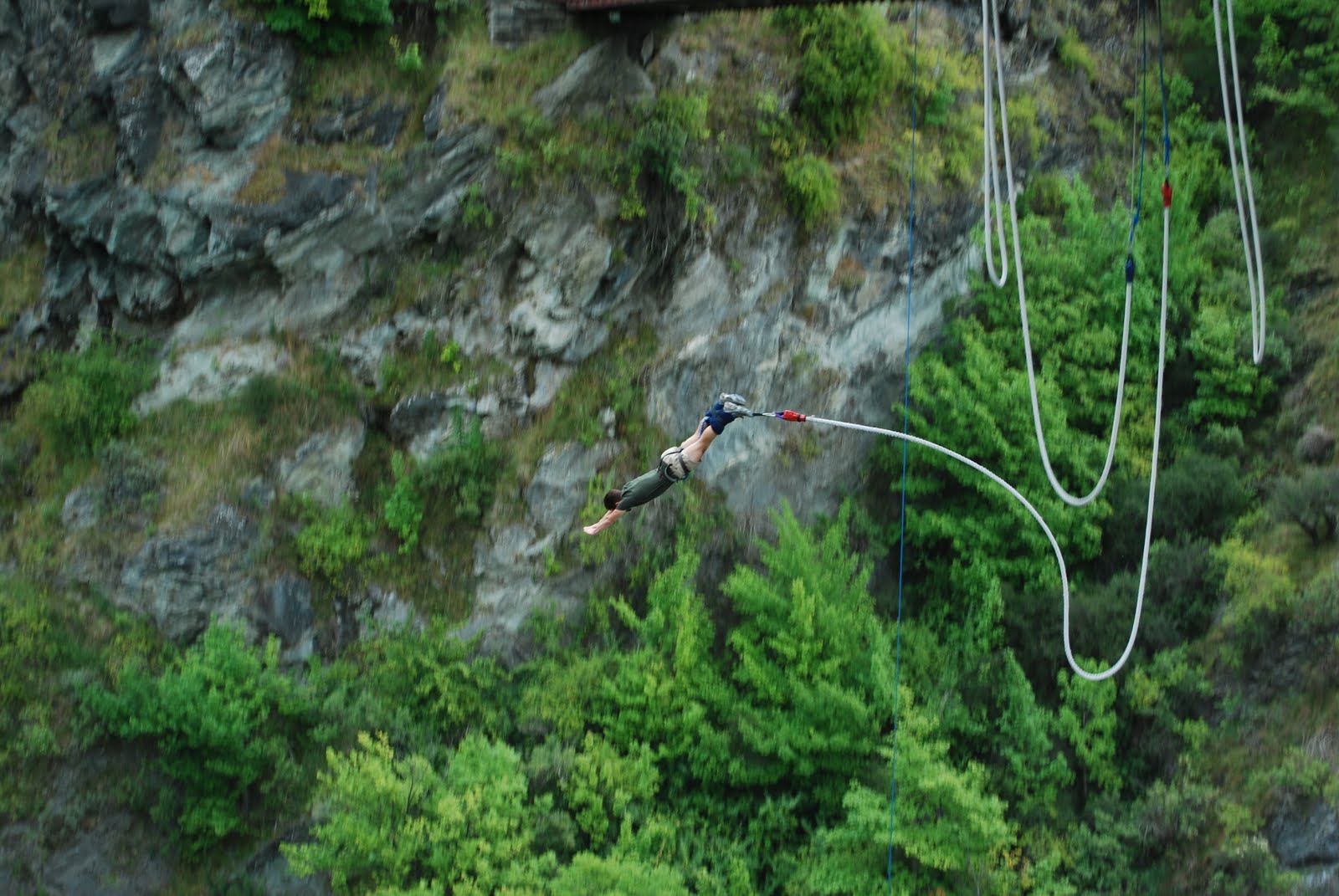
As we neared Queenstown, we stopped off at the Kawaru Bungy, the world's first and most famous bungy jump! The jumping platform is 43 meters high and suspended from the middle of a bridge over the turquoise Kawaru River. Jumpers can even reach the water on their first bounce. The Kawaru Bungy outside of Queenstown was built in the 1980s and put Queenstown on the map as a place to go to seek thrill and adventure. Oh how Queenstown has grown since then!


Kearse did his first bungy jump ever, and loved it so much that he went again, the second time jumping backward off the platform. Both times he not only touched the water, but was submerged head first up to his shins. Pretty awesome! I had zero interest in bungy jumping and was perfectly content taking pictures :) Bungy is not my type of adrenaline rush.

We moved onward toward Queenstown, passing through the suburb of Frankton. Both Queenstown and Frankton are built on the shores of beautiful Lake Wakatipu (310 meters deep, 11 degrees Celcius, and carved by a massive glacier 15,000 years ago) and are surrounded by Mount Aspiring National Park and The Remarkables Mountain Range (a popular snow skiing site that opened in the 1940s).


Queenstown is just lovely. It is a bustling town with a blend of the serenity of an alpine village and the thrill of adventure. It is the adrenaline capital of the world! Visitors come to Queenstown from all over to go jet boating, bungy jumping, canyon swinging, sky diving, white water rafting, snow skiing, rock climbing, and mountain biking. We wandered by the shops in Queenstown for a bit and met a Georgia Tech professor, Dr. Harrington. She's teaching the Australia portion of Tech's study abroad Pacific Program, and jumped the pond two weeks early to explore New Zealand. How exciting to meet a fellow Techie abroad!

The Left of Way & the Cloud in the Sky

During a lazy day in Christchurch, I did laundry, sat in a medical clinic for three hours (to get an "unknown foreign object" flushed out of my eye, it wasn't a big deal), rented a camper van for the next 12 days, and went grocery shopping to stock the van with food. 

Our camper is basically a van like those old 80's VW buses that has been gutted and outfitted with two benches for beds, a sink and faucet, a mini fridge cooler, a portable stove, and a solar shower bag (which we probably won't use because it's sketchy). The van is from Road Runner Rentals and has stickers all over it of the cartoon characters Wiley Coyote and Road Runner (my favorites)!


At 7 this morning, Kearse and I left in our van from Christchurch and headed toward Mount Cook. We'd heard that camper vans or rental cars are the best ways to get around New Zealand, rather than flying or booking a bus tour, and it's totally true. There's such a feeling of freedom and empowerment when driving across the island on your own. You can pick the cities and sites you want to visit, pullover on the side of the road when there's a good photo opp, and you do not have to worry about booking a hostel for the night (though it is nice to camp at an official site with restroom facilities and, cross your fingers, some showers).

However, the best part about renting a camper van is driving on the left hand side of the road! It's exciting, but oh so confusing. I haven't gotten behind the wheel yet, but I plan to drive a few times. Kearse will be the primary driver, and I the navigator. The steering wheel is on the right hand side of the car, and it's funny to enter the car on the opposite side. The blinker signals and windshield wipers are also on the opposite sides of the steering wheel than in the States, and it's quite hilarious when Kearse means to signal but turns on the wipers instead. It's a tough habit to break.

But luckily he's been able to break the driving on the right-hand-side-of-the-road habit easily. It's tricky puling up to an intersection where your left-hand turn is with traffic and your right-hand turn is across traffic. Parallel parking is opposite (you park with the left side of the vehicle to the curb), and you go through the roundabouts in a clockwise direction rather than counterclockwise. Also, don't forget to give others the "left" of way!

We drove a total of 6 hours through a very rich agricultural region to get to Mount Cook, plus our stops along the way. First we drove through irrigated fields with God knows what vegetables growing to get to the small town of Geraldine. It was an adorable town surrounded by pastures of black and white spotted cows and sheep that are sheared for their Morino wool. We even passed a pasture full of deer, alpacas, and Clydesdale horses! I definitely need to get a picture with an alpaca! During our stop in Geraldine, we perused a town yard sale that was raising money for the town history museum. We purchased three old school CDs to keep us entertained on the drive (the radio signal is painfully inconsistent). The CDs are Pop Hits from 2004, The 33rd CMA Awards Collection, and British Pub Songs, good times! I even happened along a country market where I got to sample tart cherry pie!

After Geraldine, we cruised through a series of three valleys: Gapes Valley, Beautiful Valley, and Cattle Valley. Imagine the view- rolling hills of varying shades of green, dotted with grazing sheep and cows, with snow-capped peaks in the background slicing the sky. It was beautiful! Let's just say I had my camera in hand the whole way!

We cruised right through the even smaller town of Fairlie (the gateway to MacKenzie country) and through Burkes Pass to arrive at our lunch stop- Lake Tekapo, a huge natural lake carved out by glaciers and filled with freezing turquoise glacier water. We enjoyed making Aussie-style sandwiches by the lake for lunch (sliced spicy pork, tomatoes, cucumbers, and avocado on multigrain bread, yum)! We then stopped by the famous Church of the Good Shepard, a quaint little stone church that has overlooked Lake Tekapo since 1935.


Near Lake Tekapo we drove to the top of Mount John to visit the Mount John Observatory. It's the southern-most observatory in the world! While at the clinic in Christchurch, I read an article about this observatory. The astronomers here are searching for planets orbiting the binary star Alpha Centauri, which is the closest star to Earth at 4 light years away. They believe that if we find a planet at Alpha Centauri, then the planet is more likely to have sustained life than not have sustained life. Apparently since Alpha Centauri is a binary star (two stars revolving around each other), the "Habitable Zone" between the stars is larger than the inhabitable zone, thus increasing the probability of a finding life on another planet. The Mount Cook observatory is the only observatory in the world that can monitor Alpha Centauri year-round because it is so far south. Alpha Centauri never dips below the horizon here! 

In addition to marveling at the huge telescopes, we enjoyed a 360 degree view of the MacKensie Region of New Zealand! We also met a local NZ couple (who used to live in Romania and Australia), who told me that my American accent was beautiful :) It's not everyday you hear that while traveling abroad!

In the afternoon, we drove through Simon's Pass to Lake Pukaki, the snow capped mountains in the background making it even more beautiful than Lake Tekapo! Lake Pukaki is fed from the north by rivers of melted glacier from the mountains, and the rivers flowing out of Lake Pukaki from the south are the home to the world's highest salmon farm! 


We drove north along the length of Lake Pukaki to reach Aoraki/Mount Cook, passing by the Glentanner Park Centre where you can ride a helicopter for a scenic view of Mount Cook and her stunning glaciers. Mount Cook is called Aoraki by the native Maori people, which means Cloud in the Sky. This name is fitting as Mount Cook is Australasia's tallest mountain, towering above the Southern Alps at 3754 meters. Australasia, also known as Oceania, is made up of Australia, New Zealand, and the surrounding Polynesian and Micronesian islands.

After parking at White Horse Hill Campsite at the foot of Mount Cook, Kearse and I embarked on the Hooker Valley Track- a three hour tramp up to the base of the Hooker Glacier and back (the New Zealanders refer to hiking as "tramping"). What an incredible tramp! 

The trail was rough, rocky, and unstable the whole way. I think I managed to have only a couple hundred sure steps during the entire hike. As we picked our way through the volcanic terrain and hopped from boulder to boulder along the glacial river where the trail disappeared, we were buffeted by a strong and cold wind. There were numerous times that I was nearly knocked from my feet! I think that if I would have jumped straight up, I would have been displaced about a foot by the wind. There were two cable bridges during the hike, both two feet wide and spanning across the rapid cloudy white river. Approaching the bridges, you could see them bouncing due to the wind. There are no words to describe crossing those bridges. The worst of course was reaching the middle where you're suspended 15 meters above the rushing water, with the bridge bouncing up and down below you, with the strongest wind at your side trying to through you over the waist high railing. No fun. All I could think was... I have to go back over these on the return trip!


Despite the weather conditions (which in retrospect made the hike way more interesting), the scenery was just incredible. It literally looked like the mountains had exploded out of the ocean in an unorganized frenzy. There were several times I would take a break from picking my way along the rocks to glance up at the snow capped mountains around us, with the ice blue glaciers hugging the rock faces, waterfalls of glacier runoff sliding down the sides, and gray rain clouds swirling above the peaks. With the cloudy white rapids to our side, the lake of white water at the base of the mountains, and the wind ripping through the tall grass all around us, I definitely felt like I was somewhere rare and unique. I hate to use this comparison, but I can find few other words to describe it- I felt like I was in Lord of the Rings. There is truly no other place like this on earth.


The destination of the track was the base of Hooker Glacier. We traversed a rock cliff to stand on the rocky shore of a cloudy white lake of glacier water, and the icy blue base of Hooker Glacier gaped at the far end of the lake. The top of the glacier was covered with gray and black dirt (matching the color of the beach we were standing on), that stretched about half way up the glacier until the white and blue ice that showed through near Mount Cook's peak. What a great reward for such a tricky hike :)

By the time we arrived back at camp, it was raining. We retreated with our portable cooking stove and food into the kitchen to cook dinner- chicken, potatoes, and red bell peppers. It sounds nice I suppose, but we were too hungry to wait for the potatoes to cook (even though I cut them really small), so we ate them half raw. W had enough chicken for three dinners, but while we had the stove fired up, we went ahead and cooked all of it. Haha then the plastic knobs on the stove melted off, and the gas can got stuck inside. We had three guys working on fixing the stove by the time Kearse decided to trash the thing. At least we cooked all of our chicken!

We went to sleep in our camper van, listening to the pouring rain outside. Around 2am the winds got so strong that they were knocking our van from side to side. I was legitimately scared that the storm was going to knock our van over. Not only that, but the sheer sound of the howling wind alone was enough to keep me awake for the rest of the night. (In fact, during the night a tree fell on the camper van two down from ours).

Luckily in the morning we were greeted by a light pink sunrise over the mountains and the soft pitter patter of the rain remaining from the night's storm. We left the rainy Mount Cook valley by 7am and drove toward the blue sky over the nearby town of Twizel.

Thursday, February 3, 2011

Cyclone Yasi

In a recent turn of events, also known as Cyclone Yasi, Kearse and I have been redirected in our travels. We Had a flight outbox Alice Springs to Cairns this morning, but the Cairns airport closed down for the next three days. The cyclone hit last night with winds averaging 143 miles per hour and topping off at 186 miles per hour! It sustained these speeds over Cairns for hours. 

I can't stop thinking about how lucky we were that we didn't decide to fly to Cairns earlier. We met some backpackers who had a friend that went on to Cairns, only to be evacuated from her hostel and seek refuge on the floor of a mall for 26 hours. Check out pictures from the cyclone. The damage is horrific.

So, based on flight prices and such, Kearse and I have decided to fly to Christchurch, New Zealand, which is exactly where I'm writing this post from. We spent the whole day traveling and made it to New Zealand by the skin of our teeth. We had a flight from Alice Springs to Sydney with one airline, a two hour layover, and then a flight to Christchurch with another airline. So we had two hours to get off the Alice Springs plane, get our bags from baggage claim, take a train to the International Terminal in Sydney, check in to our New Zealand flight, get through AUS customs and passport control, security, and then get to our gate. After security we heard the final boarding call for our flight and ended up sprinting to the boarding doors. Good times.

But we made it to New Zealand! And then we found out that there was a big earthquake in Christchurch in November, most hostels are still closed, and they've experienced over 300 aftershocks since the earthquake. Ah always an adventure.

Uluru, Kata Tjuta, and Kings Canyon

Kearse and I took a tour to some of Australia's most well-known natural wonders- Ayer's Rock and the Olgas. Ayer's Rock, here on out referred to by its aboriginal name Uluru, was seen only by its aboriginal caretakers until a little over a century ago. It's basically a giant rock in the middle of the flat, red outback. That's Australia for you- the sea, a city, the bush, the outback, the bush, a city, and another sea. Uluru and Kata Tjuta sit in the middle :) The Olgas, which are called Kata Tjuta by the Aborigines, are rock formations in the distance from Uluru. Both Kata Tjuta and Uluru hold intense spiritual significance for the Aborigines. 


Kearse and I took a flight from Sydney to Uluru, literally flying right by the rock to land at a small airport nearby. It was really neat to  fly across the Outback and see vast expanses of endless red sand dotted with green trees and bushes. The sand was, indeed, very very red, and it stains everything- shoes, socks, shirts, hats, backpacks, hands, trees, rocks, cliff faces, you name it. It reminded me of red Georgia clay and the surface of Mars. At this time, there are heaps of bushes and trees across the landscape as the Outback has seen a generous amount of rainfall this year. Apparently there is about a twelve-year cycle where the Outback goes from dry to "wet" to dry again. I'm currently seeing it in its "wet" season. Oh and there is a time change from Sydney of an hour and a half! When have you ever experienced a time change in half hour increments?? It happens across Australia.

Upon landing in Uluru, you get the feeling that you are in the middle of nowhere. The nearest town (Alice Springs) is 600 km away. There were very few workers at the airport, save for a few baggage handlers and shuttle drivers (since there's nothing out there, workers are put up in hostel-type lodging for shifts of about six months to a year). The place was hot hot hot! Extreme sunlight and hardly any breeze or shade. The temperature the day we landed was 40 degrees Celsius (about 100 F)! The shuttle driver told us that the Uluru area was cooling down, as last week it got up to 43 Celcius, and four tourists died from overexposure/dehydration! It's pretty much a law out here to have one liter of water (and drink it) for every hour you will be outside. 

Lucky for us, we ended up getting quite a bit of cloud cover and a slight breeze during the day, which was a blessing! Our tour guide also had us get up at 4:30 each morning to pack up camp and leave by 5:30. We finished all of our hikes before 11am to avoid being outside during the hottest and most dangerous part of the day. Nevertheless, there were 23 people on our tour that were crammed in to a small bus, which made the trip a hot orgy of sweat and sunscreen. I like to call it "raw humanity" as there's no way you could have possibly avoided being sweaty, greasy, and smelly. Yum!

We spent three days and two nights on this tour. Despite the blistering hot weather, we had a blast on this trip and met awesme people! Our guide was of the oldest of the group at young 25 years old. She was fun and energetic, LOVES Uluru and the Anangu people, and had the nickname Lewy. 

On our tour there was Hanna from England traveling with Nina from Germany, some of the most hilarious, good humored people I've met. Hanna and Nina met while working at a Subway in the Outback (the most visited Subway in all of Australia!), and they've been traveling together for 9 months now. They had both been traveling and needed to find work to save up money for the next part of their trip. They made $24 an hour at this Subway because it's in the middle of nowhere. Logging 70 hours a week, they were able to quickly save a lot of money. 

We also met a pair of girls from Sweden (Annika and Johanna) who met while both traveling solo; two girls from Denmark (Anne-Metta and Charlotte) who are traveling after having completed hair dressing school; three boys from Ireland who were not very talkative and kept to themselves; a girl Kaley from England who has been traveling for two years now, has no intention of returning home, and wants to marry an American boy at Elvis's chapel in Las Vegas; a local Aussie Eleanor who was super friendly and chatty; a girl Eleanora from Milan, Italy who was quiet but as sweet as can be; Natalie from Germany on a trip between college and work like Kearse and I; a girl Jill from Canada traveling solo; and 8 Koreans. Kearse and I who were dubbed Team America by creepy old dude Andi. So yes, it was a trip with lots of solo traveling girls. I enjoyed talking with them about their adventures and tips for traveling alone. I think I'm working up the courage to embark on my own for a week or so after Kearse goes back to the States to start work.

We spent the first day of the tour at Kata Tjuta, which is a rock formation with 36 domes. Kata Tjuta means "many heads" in the Anangu language and it is a sacred "men's only" place. There is a small hike in between two of the domes, but that's as far as tourists are allowed to go. There are currently trees and bushes growing here, and there were flocks and flocks of little zebra finches in this crevasse. The presence of the finches means that there is an abundance of water, and Lewy she had never seen so many of them in her 10 months of giving this tour. There were so many finches that they covered the little trees and flew in swarms right at you!

Apart from what I originally though, Kata Tjuta is actually not a rock. It is a conglomerate of rocks that you can see when you get up close. You know those wooden boards that are made with saw dust and glue? Kata Tjuta is like that, like a handful of gravel mixed with thick glue. I don't remember all of Lewy's geology spiel, but I do remember her saying that the conglomerate formed underground and then broke and came through the surface of the earth like a compound fracture. On the other hand, Uluru is a solid rock mass (like Stone Mountain) that broke up through the surface in the same manner


That evening we watched the sun set on Uluru as the rock face changed from red-orange to a deep purple. We barbecued thin kangaroo steaks and camel sausages for dinner back at camp (with salads and couscous with zucchini), and then slept out that night in swags. A swag is like a canvas sleeping bag with a mattress sewn in the bottom. You place your real sleeping bag inside the swag, as well as your shoes, flashlight ("torch" in Aussie), etc. I ended up just sleeping on top of my swag because it was so hot. Lewy's swag was pretty tricked out with bed sheets and pillows (because she sleeps in her swag on tour more often than in her bed). It's common for Aussies to have their own swags, as Eleanor has one at home and often sleeps in it on the floor in front of the TV (or "tele" as they say in AUS). 

I taught the others that a "swag" in the U.S. is your walk, your swagger. So then we all walked around with swag while laying out our swags. Quite entertaining! I was looking forward to seeing a sky full of stars the first night (as the closest major light source is 600 km away in Alice Springs, but it was cloudy that night so I saw very few stars. However I did see the Southern Cross low on the horizon! The Southern Cross is a constellation that you can only see in the southern hemisphere, mainly in Australia, and it's something I've been just dying to see in my lifetime. Take a look at the Australian flag, it has the Southern Cross on it.

The next morning we left camp at 5:30am to watch the sunrise at Uluru. The rock face changed from a dark blue to a light purple and then to its daytime red. Actually, the surface Uluru is only red because of the red sand being blown into the rock. Underneath the thin layer of red, Uluru is gray. Watching the sunrise reminded me of being in Inner Mongolia when we got up early and watched the sun rise over the grasslands. 


After the sunrise, we did a 10 km walk around the base of Uluru. I had no idea that there was so much at the rock! It's like a little city! Caves have formed around the base of the rock that served as dwellings for the Anangu. Many of the caves are separate and sacred men's and women's areas only, and we don't know what they were used for. However, there was also a "kitchen" where the rocks had been smoothed away by the continuous grinding of seeds and fruits. These seeds and fruits were mixed with animal fat and stored in the crevasses of the rock to make granola bars, fascinating! There was also a "learning cave" where the Anangu children were taught stories and lessons. The rock face was used as a drawing board and had Anangu paintings all over it! There were no erasers ("dusters" in Aussie) though, so there are layers of paintings painted over paintings. There are black trails down the sides of Uluru that were made by water when it rains on Uluru. The trails looked like the shadows of waterfalls. It would've been neat to see water actually flow down Uluru. There was even a watering hole and little forest of trees nestled in part of the base. I saw a dingo here!


After our base walk, we ate sandwiches and drove 4 hours to Kings Canyon. We saw wild camels, red kangaroos, and wild horses along the way! We also stopped for a view of Mount Cooper and a salt lake. All of the salt lakes are dried up in the Outback, but they left behind a thick and soft layer of salt, like what would remain if you were to you boil a pot of salty water.

We made spaghetti dinner that night. Or should I say, Kearse made spaghetti dinner that night for the whole tour. What a champ! Much like their sandwiches, Aussies will put anything in their spaghetti sauce, and I will probably adopt some of their ingredients back home, especially the carrots and zucchini, yum! 

There was a thunderstorm for about an hour that evening. The lightening was magnificent and the thunders REALLY loud, but the downpour chased everyone into their tents. I waited out the storm, hoping the sky would clear up afterward so I could see some stars. What a reward! Kearse, Hanna, Nina, and I pulled our swags outside (the ground, like a thirsty sponge, had already sucked up all of the rain water) and gazed up at the stars. The sky was full of them! There were so many stars crowding within and around Orion that you could hardly make out the constellation itself! There's actually a line of stars that vary in brightness to look like 3-D telescope scooting out of the sky. (This is placed right above the popular three star line in Orion, which many believe the placement of the Great Pyramids of Giza was modeled after). Because of all of the stars, I had difficulty locating the Southern Cross. I tried to get a picture but it wouldn't come out. The Big Dipper was also difficult to spot as it is upside-down compared to how we see it in the U.S. We could also see the Milky Way stretch across the sky, and I spotted three shooting stars lower on the horizon!

The next morning we rose early for our 6 km rim walk at Kings Canyon. There are several warnings about the rim walk, not only because it is hot and you need to bring ample supplies or water, but also because you will be walking along cliffs made of sandstone. If you get to close to the edge, the rock beneath you can crumble and fall. Lewy even told us that hikers with backpacks should watch out, as one time a man turned and knocked his daughter off a 150 meter high cliff with his backpack... 


The first part of the hike is named Heart Attack Hill, as it is a steep climb from the base of the canyon up to the top. Afterward, it's a nice hike along the top "in full sun" as Lewy liked to say. Like Uluru, Kings Canyon appears to be made of red rock. However, King's Canyon is actually white underneath the thin layer of red. There is even a watering hole at the base of the canyon that is surrounded by gum trees and called the Garden of Eden

There are over 600 species of plants at Kings Canyon. If that doesn't seem like much, think about this- there are only 60 species of plants by Uluru. Lewy taught us about several of the trees and bushes at the top of the canyon- ghost gums that have white bark to protect them from the sun, the tree that the Anangu made spears out of because it has a toxin that paralyzes, and a bush with leaves that can temporarily blind you if you touch them and then touch your eyes (the Anangu would punish people by blinding them and leaving them in the Outback. When the blindness wore off, they faced the challenge of finding their way back. There's also a poison bush that the Anangu would collect to later burn off the poisonous casing and eat the healthy inside. When the white man saw the Anangu picking these leaves, they assumed it was safe and did the same. The white man never saw the burning process, so they would die from eating the poisonous parts. The Anangu thought this was a great fortune, and would often trick the white man in this way. Interesting.


We finished the day with classic Australian sandwiches, and I saw a huge Red Back (black widow spider) in the bathroom!! I've got a disgusting picture of it. We then piled in the bus for the 500 km drive back to Alice Springs. The nearest public bathroom was 300 km away (about 3 hours), so yes, we were in the middle of no where. It was kind of neat thinking about where I was on a map at that time- smack dab in the middle of Australia. Crazy! On our way home, we saw rain storms in the distant, and then ended up driving through a hail storm! Twice! Ice falling from the sky in the desert! It was insane! You couldn't even see the road because of all the rain, fog, and hail. I'm adding it to my list of abnormal occurrences- rainstorm in the Gobi Desert while riding camels, rain in Egypt for the first time in 8 months, and now hail in the Outback.

We arrived in Alice Springs that evening. I was excited about seeing the little town, but there wasn't much to it. I didn't feel very safe there either. Lewy booked us a table at a bar Annie's, which was an awesome time. We all had $5 fish and chips, drinks at the bar, and then said our goodbyes at the end of the night. I'm so glad we did the tour! There's really no other way to see Uluru. It was a great experience with great people!

A Look Into Aboriginal Culture

I spent a little more than three days in the Northern Territory of Australia, also known as the Outback and the Red Center, at Ayer's Rock National Park, King's Canyon, and Alice Springs.

Before diving into details from the trip, I'd like to write about the aboriginal people, now officially referred to by the name they call themselves - Anangu, which means "people" in their language. 

Here is a note on the Anangu's come to being in Australia from Bill Bryson:

"At some undetermined point in the great immensity of its past- perhaps 45,000 years ago, perhaps 60,000 years ago, but certainly before there were modern humans in the Americas or Europe- Australia was quietly invaded by a deeply inscrutable people, the Aborigines, who have no clearly evident racial or linguistic kinship to their neighbors in the region, and whose presence in Australia can only be explained by positing that they invented and mastered oceangoing craft at least 30,000 years in advance of anyone else, in order to undertake an exodus, then forgot or abandoned nearly all they had learned and scarcely ever bothered with the open sea again.

It is an accomplishment so singular and extraordinary, so uncomfortable with scrutiny, that most histories breeze over it in a paragraph or two, then move on to the second, more explicable invasion- the one that begins with the arrival of Captain James Cook in 1770."

So, the Anangu have been living in Australia for a LONG time. I remember being intrigued at seeing the Egyptian pyramids and hieroglyphics that were built and carved 4,500 years ago, but in The Outback I saw cave dwellings and paintings that have been around for over ten times as long! It's inconceivable. In fact, the Anangu people lead the longest, uninterrupted lives in world history. They live on the same land, tell the same stories, and survive almost the same way as they did 45,000 years ago.

I wish I could share a lot about the Anangu, but very few people have insight into their culture, stories, and beliefs. The Anangu belief that knowledge about their culture must be gradually learned, like starting in kindergarten, then moving to 1st grade, 2nd grade, etc., like how a kindergartener cannot start learning calculus without mastering basic arithmetic. In order to learn from the Anangu, each person must start at the beginning. Hence, there are very little explanatory signs at Anangu sacred sites for tourists, and there is very little explanation in the cultural center/museum about Anangu tools, trades, and way of life. There are a few stories that are shared with tourists, but apparently the Anangu only share the versions that are appropriate for a kindergartener to know.

The Anangu people have evolved with dark skin for protection from the sun, thick leather feet for walking on hot sand and prickly plants, and are very tall and have wide noses. They are partially nomadic, meaning that they settle in areas for a short time before moving on again. They travel from home to home, taking only light tools with them and leaving behind their heavy stone tools for the next family to use. They know where to find watering holes, where to find honey ants for food, and how to make sunscreen to protect themselves from the harsh sun.

The Anangu have very strict barriers between men and women. There are things that only women do (gather fruits and seeds, track small animals, make small tools and bowls, raise children) and things that only men do (hunt kangaroo, make fires, make medicines, make spears). The Anangu are so focused on surviving in the hostile environment that they do not have time to learn everything. Hence, women have never known for thousands of years how to hunt kangaroos, and men have never learned how to find fruit and mix them with seeds and animal fat to make granola bars. But we do know that the men through toxic spears at the kangaroo's legs to paralyze them. The hunter would carry the kangaroo back alive so that the meat didn't spoil in the hot sun during the several kilometer trek by to the family. (Side note: there's a plant in the Outback that has leaves that smell like Vick's vapor rub that the men would mix into a salve and put on their sore shoulders after carrying the kangaroo back).

In fact, there are sacred areas around Uluru (Ayer's Rock) that are designated only for men and only for women. Tourists are not allowed to take pictures of these spiritual sites (which are usually caves and outcropping at the base of the rock). There is no explanation as to why the Anangu find these gender specific areas sacred, but there is a $5000 fine for taking a picture of one. My theory is that these areas were used as locker rooms, like an Anangu woman retreats to a woman's only area during her monthly or when she's having a child.

The arrival of the white man into Anangu land has been quite devastating for the Anangu culture. The Anangu men used controlled fires for thousands of years to burn the land. They understood that the heat from the fires enabled certain seeds to open their shells and that the fire helped certain trees to regenerate, while the aftermath of the fires brought in kangaroos. The plants and animals of the Outback were as reliant on the Anangu as the Anangu were reliant on them for survival. The Anangu were as much a part of the land as the flora and fauna. 

When the white man saw the Anangu burning the land, the Anangu were ordered to stop. The white man didn't understand the importance of the burning, and the Anangu couldn't (or wouldn't) communicate their reasons. Because the Anangu were not allowed to set off their controlled fires, years later devastating forest fires ripped wildly through much of the Northern Territory, killing several people and wiping out entire species of plants and animals. After this, the Anangu were allowed to start burning the land again, as it helped keep the environment in balance.

The Anangu diet was based on fruits, seeds, and meat. They ate very little sugar - the equivalent to 3 Mars bars in one years. I think I've consumed the equivalent of 3 Mars bars in the last few days... So when the white man came and used alcohol and foreign foods to bargain with the Anangu, the Anangu's bodies had terrible reactions to the introduction of so much sugar into their diets. To this day, the Anangu suffer greatly from diabetes, as their body systems had never developed to handle as much sugar as they consume today. In fact, almost every Anangu I saw was overweight, again I think because their bodies have not evolved to handle our kinds of food.

Around the Ayer's Rock area, the Anangu were quite peaceful. They were friendly and willing to help us understand the sacredness of their culture and lifestyle. I admired how there are several Anangu on the Ayer's Rock National Park Board who work with the white man to protect the rock and keep the tourists safe. 

However, in Alice Springs (the most remote city in AUS, right in the middle of the Outback), I found the Anangu to be hostile (and this is the tough part to write). At night in Alice Springs, Brandon and I were walking a German girl we met on our tour back to her hostel. Along the way, there were hoards of Anangu on the streets. It was late at night, but they were very much awake, it was unnerving. As we walked through the city center (along little shops that had closed their business for the night), a large male Aborigine assaulted the three of us. There's really no other way to put it. He must've been drunk I guess, but as he walked by, he threw his shoulder into Brandon and then advanced on Natalie and I. It was one of those slow motion moments, where your body switches into fight or flight mode. For the three of us, it was fight I suppose, as we held our ground, pushed out our arms and just said Stop Stop Stop. He screamed at us that this was Aboriginal land and we didn't belong, and that he was a monster and was going to chase us. At this point we had started cautiously walking away, and he didn't follow us. We made it to the hostel around the corner, but of course everything was shut down for the night. Since Brandon and I still had to get back to our hostel (which required walking right back through the same streets), we called the police from a pay phone to get an escort car (all the taxi places were closed). The operator politely said "The police are dealing with more important matters. I'm sorry, we can't help you." I was furious, and after several attempts at calling a taxi company, we finally managed to get a taxi to come pick us up and take us back to our hostel (where the gates had been shut for the night and we had to climb a fence to get back into the complex only to find the hostel staff having a late night pool party. Lovely.)

So that qualifies as one of my scarier travel moments where you fet that rush of fear and adrenaline (right up there with the rickshaw drivers who tried to take us to the Underground City in Beijing). I hate to end this post on such a bad note, especially since the Aborigine culture is truly astounding, but that's how I left Alice Springs. I don't think I will be returning.